My Name is Blur. I have Antenna. I am a City Doctor.
Facing Middletown- The Facing Project
John West's story as written by Aimee Robertson-West
This is my life.
Not the extra one. The real one. The one I was not guaranteed.
I belonged to Pittsburgh, and other places along the way, and now I belong to Muncie. I understand escaping what to many others was certain doom, has inspired deliberate urgency in my everyday life. Let me explain.
My formative years of adolescence were not lived in playgrounds or classrooms, but rather in hospital spaces and corridors. I am a survivor of childhood leukemia during a serendipitous time — treatment innovations (public investments in supportive care, better infection control, better understanding of molecular and cytogenetic anomalies) meant that the rate of survival for kids like me increased by 20 percentage points. Up from around 50% to nearly 67% (for boys, 71% for girls my age.) I knew what I was facing and the odds were daunting. Half of us would make it. And I did. I am here, after all, 33 years later.
And as I consider my life now, today, I must remember what I survived then, as I encounter fear and uncertainty, in different ways. What do I remember about that time? What I remember most is the precision in that atmosphere: the sterile scent of antiseptics, the low hum of machines, the disciplined calm of oncologists and nurses who moved around me with purpose. The measured empathic presence against unbearably painful procedures like spinal taps, which would ultimately go on to save my life. I trusted them, and my life and future self was in their hands.
My mother, Marlene, who took leave from her executive role at Pittsburgh Children's Hospital, slept in chairs designed for waiting, not for comfort. I know now the sacrifices she made. My father, Ralph, steady and reassuring, shouldering his fear without letting it spill over onto me. He promised me when it was safe for my immune system, a new puppy was waiting for me upon remission. I wonder what he remembers of this time. His memory is fading now. My aunts, uncles, cousins, and friends formed a circle of care around our family. My survival was never mine alone. I somehow ended up on the Make-A-Wish list: through an extraordinary interlude to the Academy Awards, with Billy Crystal escorting a pale, wide-eyed kid down a red carpet. I did not feel well. I had no hair, but I understood the gravity of this moment, and I am forever grateful for the care and dignity Mr. Crystal showed to me; extending beyond the performative into lasting care and connection. Spectacle fades. Care is what sustains. And a basset hound named Floppy.
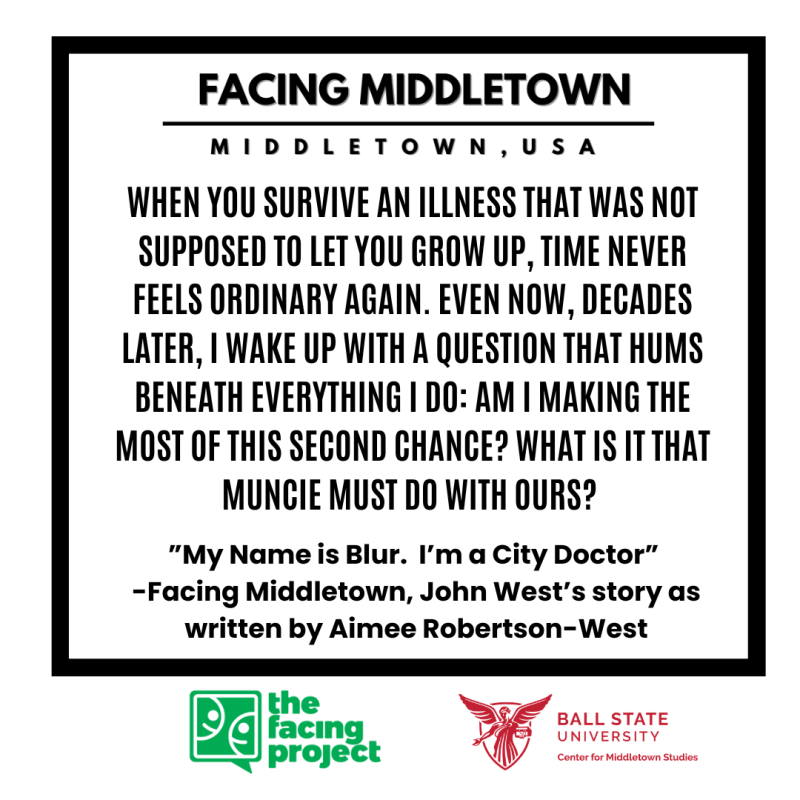
When you survive an illness that was not supposed to let you grow up, time never feels ordinary again. Even now, decades later, I wake up with a question that hums beneath everything I do: Am I making the most of this second chance? What is it that Muncie must do with ours?
My path wound through Kenyon College, through years in Chicago, Madison, and New York City. I lived abroad in France and Tanzania. I saw cities where public life was cultivated with intention and others where it had been hollowed out. I earned my PhD in Urban Planning from Columbia University, learning to name the forces I had long sensed — how policy shapes land, how land shapes opportunity, and how neglect is often a decision.
I thought I might spend my life moving between case studies and conferences.
Then I came to Muncie, and I met Aimee, who held me accountable to the idea that this place was not just a site of analysis for me, but a place for roots, to love and protect. Through the Facing Project and Facing Middletown, she is documenting its losses, its endurance, its creative stubbornness. She knows Muncie as a living story, not a problem statement, and imprinted upon me the same.
At Ball State, I teach planning history, land policy, housing, and the structural dimensions of inequality. But my most formative education has happened off campus, walking neighborhoods where abandonment had become normal, where vacant houses stood like unhealed wounds.
That is where the idea for the Muncie Land Bank took shape.
On paper, land banking is technical: tax foreclosures, liens, title clearance, statutory authority. In practice, it is about who gets to shape a neighborhood’s future. We built the Muncie Land Bank as the first of its kind in Indiana, not as a vehicle for speculation, but as a tool to return neglected property to stabilizing, community-centered use.
We began with neighbors; The woman who had lived beside a collapsing house for twenty years. The family who wanted a safe yard for their kids. Places and people that deserve dignity and agency. Sometimes, during tense and important milestones for the landbank, I remember my vulnerable self, a kid facing down cancer, reliant on the expertise and navigation of those tasked with my care. I know that I now must become them, someone whose sole responsibility is to ensure this work, these neighbors, and their lives, withstand competing political and economic interests. Land is never neutral.
One half-day school afternoon, many months ago, my son, Daniel, 6, drew a nonsensical character who he called "Blur", the city doctor who has an antenna, on my office white board. I find myself unwilling to erase it.
Doctors don’t choose easy cases. If they did have antennae, perhaps they are to find what hurts and is in disrepair. A medical doctor understands it is their job to know what needs repair and to apply their knowledge to save lives. A city doctor's job, I think, is to also know what places need repair, to help the people there fix them. Both, above all, work to prevent and mitigate harm. That’s how I think about cities. It is my job to know as much as I can, and to apply that knowledge to build enduring resilience in cities. Let me be clear; Muncie is not a place to fix; but it is vulnerable and without care and foresight, its future is uncertain.
Today, my role here feels both urgent and fragile. Public funding shrinks even as needs grow. Civic life is strained by division and distrust and eroding academic freedom and ever-changing limits on speech. The safety nets that held previous generations are thinning. The lifesaving advances made during my childhood which allowed me to survive cancer, are quickly disintegrating for today's children. The public investments of yesterday are the reserves we're living on, today. They will run out soon. I know what it is to depend on systems that may or may not hold. I know how much survival relies on whether people show up.
I am alive because people showed up for me.
That knowledge shapes how I see my work and my purpose. When I ask whether I am making the most of this life, the answer is not measured in publications or titles. It is in church-basement meetings, in conversations with pastors, students, citizens, and with people who trust me during their own moments of vulnerability.
Aimee and I are raising a blended family of four here. Our lives are stitched into this place — Loving Muncie has meant staying through complexity, funding gaps, through strange political headwinds, through moments when it would have been easier to look elsewhere. It has meant recognizing that a city is a reciprocal relationship, not a case study.
Muncie is valuable. Its people are worthy of protection and investment. It is also, like many places, vulnerable in a changing country. I feel that vulnerability keenly, yet I encounter systems unwilling to acknowledge this vulnerability that so many of the people living here see and feel in our everyday lives. Relationships between neighbors are strong, but their connections to the systems that support them are fragile. But fragile does not mean doomed. It means they are worth acknowledging.
I am a city doctor, and my practice is simple in theory, hard in execution: who is my "patient"? Is it the place or the people within it? To help a place, I must help the people within it but try going into a place and telling the people they need fixing and see how that goes....
So, instead I stay. I listen. I sit with neighbors and students during important trials and tribulations. As my parents and doctors did with me during my own struggle. I try my very best to center the people who live here, with the understanding that behind every parcel number is a story, a family, a possibility. Ongoing trauma, work toward repair, even when it is slow and incomplete.
The boy in a hospital bed in Pittsburgh could not have imagined this life — teaching future planners, helping reshape neighborhoods in a small Indiana city, building a family, feeling responsible to a place. Yet here I am, still guided by the same questions:
What is my purpose?
How can I honor the life I was given?
How can I help this place endure changes?
Each day in Muncie, I try to answer its call with the only tools I know: attention, persistence, and care.
My Name is Blur. I have Antenna. I am a City Doctor.