Middletown researchers Dwight Hoover (left) and John Dewitt (right) in 1987.
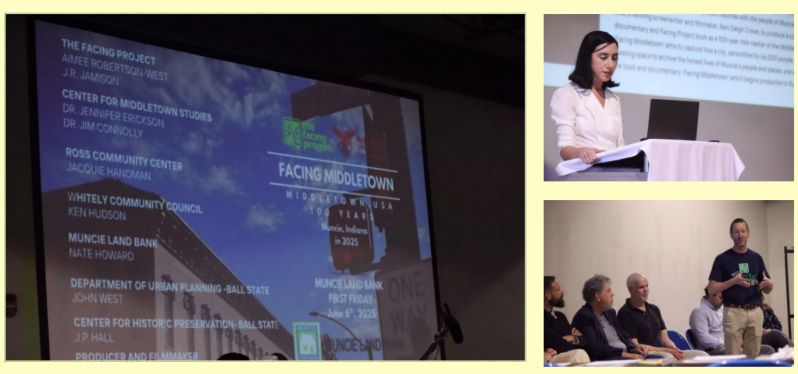
Editor's note: The 'Facing Middletown' steering committee launched its engagement efforts at Muncie Land Bank's 'First Friday' at Madjax, June 8th, 2025.
Daisy Dale, life-long Muncie resident, reflects on missed opportunities, the Middletown Studies' portrayal of Muncie decades ago, and shares her aspirations of what 'Facing Middletown' could help Muncie discover about itself, for the future.
My Hometown Is More Than a Case Study
Daisy Dale
On June 8th, 2025, a launch was held for an upcoming book and documentary on Muncie. Of course, if you’re familiar with our reputation as the typical American town, it won’t surprise you to hear that the project is titled “‘Facing Middletown – 100 Years Muncie, Indiana in 2025.” In its current stage, a group of Middletown researchers, filmmakers and others will be facilitating discussions, interviewing locals, and salvaging their daily lives through videos and writings.
Regardless of whether you see Muncie as the most average city in America, it admittedly would be great to see how we underwent events like deindustrialization or the COVID-19 pandemic. Since I recently wrote a book about Muncie in the 1910s, the Middletown studies were a benefit to me. But part of me can’t stand seeing us be reduced down to that study, to the point that I made zero mention of the Middletown studies in the book (besides footnotes at the tail end), and only gave faint mention of the authors who wrote it. It’s ostensibly the same way I feel when Muncie is only thought of as the place of Garfield or David Letterman or the Ball family, but above all I just have a hard time seeing us as a standard city.
To me, Muncie’s an eccentric labor town at heart. That might not be how people doing real estate deals in our town see it, or it might be a step off from how my civically involved friends even do, but I’ve decidedly held onto that view. From conversations I’ve had with the people running this new chapter of the study, they’re aware that it needs to be done right and not just show academics and businesspeople talking about their experiences. But did the original study by the Lynd’s even reveal Muncie as the most average city? Likely not. Though the significance of it has more to do with what it’s meant over the past century than the Lynd’s exactly “hitting the dot” with the original two books.
Muncie being chosen in the study was a lucky accident. Earlier on in its development, South Bend was also being considered, as well as Jackson, Michigan, Rockford, Illinois, Steubenville, Ohio and Kenosha, Wisconsin.1 Ironically, John D. Rockefeller had a big role in funding what was originally called the “Small City Study.” While author Robert Lynd despised Rockefeller, even writing scandalous articles on that “blue-blooded” oil baron, Rockefeller managed to have an influence on how the study portrayed economic class and religion.
Secondly, even though the first book was written at a time when the Ku Klux Klan had a massive domination over the city, and the whole state of Indiana, they did very little to capture it in the book. There are some pretty revealing interview notes that can be found in the personal papers of the Lynds, but despite the terror of the Invisible Empire in those years it wasn’t written about nearly enough. When it came to Muncie’s Black community, who were segregated in public parks because of Klan activity, they were largely ignored in the books because the Lynd’s spent more time writing about white Protestants. And so years later when The Other Side of Middletown was published, the 2001 book tried to address that omission by compiling essays from Black community leaders, and including what was excluded about the 1920s.
As an alternative, for a better sense of our community and what to make of it, we should look at how some of our local historians and activists shaped Muncie’s identity. Hurley Goodall (1927-2021) was a politician who saw value not only in serving in the Indiana House of Representatives, but through salvaging the history of our hometown. His contributions range from research on Frederick Douglass’s 1880 visit here to being the driving force behind The Other Side of Middletown, and that’s on top of writing other books and donating a vast number of writings and research to Bracken library. Bob Cunningham (1928-2005) prioritized historic preservation, both while mayor in the 1970s and throughout his whole life. He painstakingly compiled all city election results into two of his own books, as a cartoonist made the Growing Up in Middletown series, and like Goodall donated his research to Bracken (some materials of his even date back to the 1890s).
I can’t pretend I have the clearest idea of what our community today embodies. We’re more fragmented than ever before and we have less and less spaces in our city to interact with each other, so it makes it nearly impossible to decipher that question. But putting Muncie in the spotlight again has a lot of great potential for us, and there’s no reason to believe that our fame should start and end there. Right now, the project is open to finding residents to tell their stories, and we have an opportunity for this not to have the same faults from before.
Daisy Dale is the Publisher of the Muncie Post Democrat, where "My Hometown is More than a Case Study" is also published.