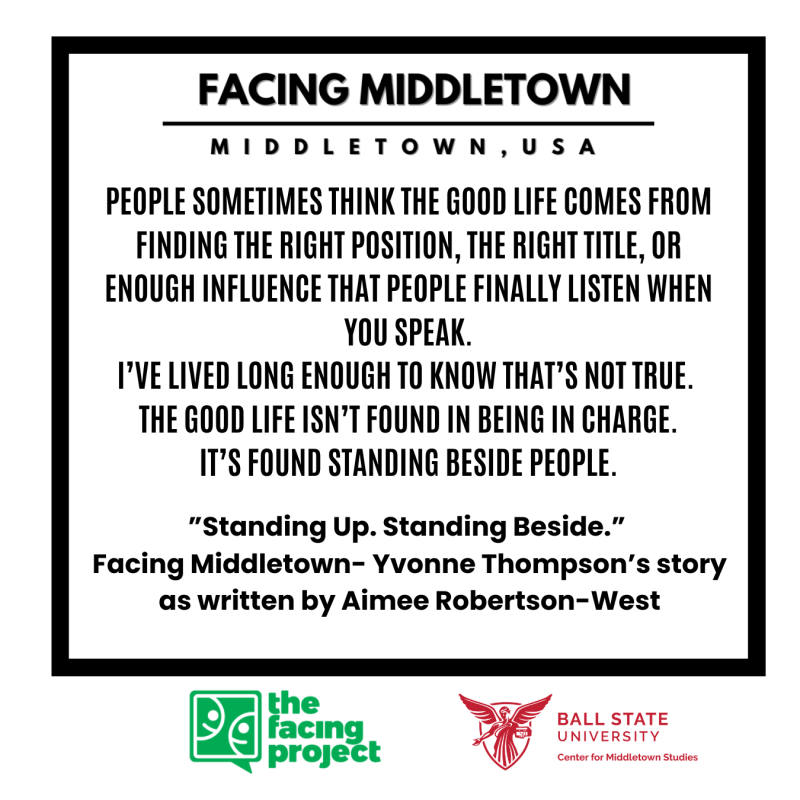
Standing up, Standing Beside
Facing Middletown
Yvonne Thompson’s story as written by Aimee Robertson-West.
People sometimes think the good life comes from finding the right position, the right title, or enough influence that people finally listen when you speak.
I’ve lived long enough to know that’s not true.
The good life isn’t found in being in charge.
It’s found standing beside people.
But what happens when we stop standing beside each other?
Sometimes that means standing beside people while they win. Sometimes it means standing beside them while they lose. Sometimes it means sticking your neck out when you know you’ll be criticized, misunderstood, or told to stay in your lane.
And sometimes it means asking yourself what kind of community we become if we choose not to.
That’s the life I’ve tried to live.
I grew up in a two-parent home where I was loved, protected, and encouraged. I did all those things that little girls dream about. My father owned a service station on Broadway. My mother worked hard outside the home. My uncles owned businesses, too. Looking back now, I understand how remarkable that was. Yes. As a black family, we paddled upstream, and somehow managed to find the stable ground others, no matter color or creed, have yet to find.
Most of all, the adults in my life were people who believed they could build something, and they did.
But I also wonder now—what happens when fewer children see those examples? What happens when possibility becomes harder to recognize?
I remember my teacher Mrs. Mary Dollison at Longfellow, made every child feel like they belonged. I’ve never forgotten that.
She looked like me.
That mattered.
As a Black child in the 1960s, seeing a Black teacher wasn’t just comforting. It told me that I belonged in places where decisions were made. It told me I could become someone who could help others.
Representation matters because possibility matters.
And I wonder who our children are seeing now? Who is showing them what they can become?
Growing up, I thought everyone treated me the same.
Looking back, I know they didn’t.
There were moments I didn’t understand then but recognize now. Being called “mammy.” Being the only Black student in certain organizations. Little things that carried the weight of something much larger.
Still, I was shielded.
But what happens to the children who aren’t?
When I wasn’t at school, I was at home.
When I wasn’t at home, I was at church.
Church shaped my faith, but it also shaped how I saw people. I honestly believed everyone was good. Maybe I was naïve. Maybe that’s what happens when you’re surrounded by love.
I had a white friend who became one of the greatest gifts of my childhood. I’d stay overnight with her family. We’d go to each other’s churches. There weren’t invisible lines between us. She showed me another way of living—that friendship didn’t have to be divided by race.
I’ve carried that lesson my entire life.
And I wonder—what happens when those friendships don’t form? When we retreat into separate spaces and stop crossing the lines that divide us?
Like many young people, I thought life was somewhere else.
Honestly, I figured my future was working at Muncie Mall.
That was big time to me.
And now, the Muncie Mall is being demolished.
My family imagined I’d stay here and work at General Motors. I even applied.
I didn’t get the job.
And now, all that’s left of General Motors is a superfund brownfield.
Looking back, I know God had another plan, not only for me, but Muncie, too.
But I also wonder—how many doors close for people without another one opening? How many dreams quietly disappear?
I wanted to leave. My parents couldn’t understand it. They had left the South searching for opportunity. They had sacrificed to build a life in Muncie. Why would I want to leave everything they’d worked for?
Because I wanted to see the world.
I believed God was calling me to Oral Roberts University. I even flew to Oklahoma by myself to visit the campus. I was dating Aaron then, and when I came home I prayed, “Lord, if you want me to go there, you’re going to have to work on Aaron’s heart.”
God has a sense of humor.
Aaron went to Oral Roberts before I did.
I worked. I raised our children. I held life together.
Fifteen years later, I finally graduated with my degree in social work.
That education changed me.
It opened my eyes to pain.
To injustice.
To how deeply people long to become the people they believe they’re meant to be.
And once you see that, you can’t unsee it.
For years we lived in Michigan City, Kentucky, Oklahoma.
Everything felt more exciting than Muncie.
So imagine my surprise when life brought me home.
After my divorce, I returned to care for my mother. When she passed away, I had a choice.
Stay.
Or leave again.
I stayed.
And something unexpected happened.
I fell in love with Muncie.
Not the version I’d imagined as a teenager.
The real one.
But loving a place means seeing it clearly.
It means asking hard questions about what it is—and what it could become.
I started visiting places I’d never explored growing up. Ball State. Minnetrista. Neighborhoods I’d overlooked. Organizations I’d never known.
For the first time, I became part of a community outside the walls of my church.
Muncie Black Expo.
Whitely Community Council.
Habitat for Humanity.
Motivate Our Minds.
Women like Mary Dollison, Maria Hawkins, and Miss Foster showed me that loving a community isn’t something you say.
It’s something you practice.
And I wonder—what happens when fewer people practice it?
People have opinions about Whitely who have never walked its streets.
I wish they’d come with me.
Everybody waves.
Everybody knows somebody.
Everybody has a story.
But what happens when we stop listening to those stories?
If you asked, I’d gladly give you a tour.
Because this neighborhood raised me.
Mary Dollison eventually invited me to lead Motivate Our Minds, the very organization she had founded after inspiring me as a little girl.
Life has a beautiful way of coming full circle.
But circles can break if we don’t keep them going.
At MOMs, we helped children discover that learning could be joyful. We taught reading and math, but we also taught violin, choir, confidence, resilience.
We weren’t just preparing students for tests.
We were preparing them for life.
And I wonder—who will prepare them if we don’t?
Later I became Executive Director of the Muncie Human Rights Commission.
If I’d understood everything that job would show me before I accepted it…
I probably would’ve been afraid.
People often think discrimination is an abstract idea until it happens to them.
I have watched people walk through our doors completely shaken.
Not because they lost a job.
Not because they lost housing.
But because someone had told them, in one way or another, that they didn’t matter.
That they weren’t worthy.
That kind of wound reaches deep.
And I ask myself—what kind of city allows that message to keep being sent?
Our job wasn’t only to investigate whether laws had been broken.
It was to help people recover something they thought had been taken from them.
Their dignity.
I’ve cried over the things I’ve seen.
I’ve cried because I’ve watched people do everything society asked of them, work hard, follow the rules, pull themselves up by their bootstraps, only to discover systems quietly pushing them backward.
I’ve seen racism in housing.
I’ve seen it in schools.
I’ve seen it in policing.
I’ve seen it hiding in places where many people don’t even realize it’s operating.
And I wonder—what happens if we keep pretending it isn’t there?
Growing up changes you.
As a child, I thought everybody was good.
As an adult, I know everyone isn’t.
But I still believe there is good inside every person.
That’s what keeps me going.
Because if we stop believing that, what do we have left?
People ask why I stayed in this work so long.
Because people need someone willing to notice them.
To really see them.
I’ve always wondered why strangers told me their life stories.
Now I understand.
People aren’t always looking for someone to solve their problems.
Sometimes they’re simply looking for someone who won’t look away.
And I wonder—what happens when everyone looks away?
That’s leadership.
Leadership isn’t standing above people.
It’s standing beside them.
Sometimes you’ll win together.
Sometimes you’ll lose together.
But what happens when we stop standing together at all?
Communities are like people.
Muncie has had victories.
Muncie has known heartbreak.
So have I.
The measure isn’t whether you avoid the hard seasons.
It’s whether you keep showing up through them.
Whether you keep believing people are worth protecting.
Whether you keep sticking your neck out for what you know is right.
Whether you inspire someone else to do the same.
Because if we don’t—who will?
If I’ve learned anything, it’s this:
Positions come and go.
Titles retire.
Buildings change.
But what happens to a place when people stop standing beside each other?
What remains is whether people remember that when they were hurting, someone stood beside them.
Or whether they remember that no one did.
That’s the legacy I hope I’ve left.
And it’s the question I leave behind.
Every morning I still pray the same simple prayer.
Lord, let me really see people.
See them in their pain.
See them in their joy.
See them in their hurt.
See them in their shine.
And help me never turn away.
Because if we can still see each other—
Maybe there’s still hope for Muncie yet.